- I have started a new book this month that is named ‘Practical statistics for Data Scientists’.
- Todays topics are mostly from that book. The first chapter is Exploratoty data analysis. Although I know most of these concepts, I would still like to document the learnings for the sake of completness.
- The first steps for any project is analysing the raw data, filtering, and structure the data into a ‘more easy for the machine or algorithm’ way to train a statistical model.
- The structured data could be either
- Numeric: Data Expressed as Numericals
- Continuous :
- Discrete
- Categorical: The data takes a set of values (ex types of tv screens: Lcd:1; plasma:2,..)
- Binary: 0 or 1
- Ordinal: Ordered categories.
- Numeric: Data Expressed as Numericals
- Rectangular data:
- For analysis, the data is mostly organised in a rectangular frame (2D matrix) of reference in most of the softwares like spread sheets ot databases.
- The columns are called as Features that are used to predict a value called target variable.
- To predict weather, we could used features like humidity, windspeed, sunny..
- The rows are the records or observations.
- The data could be Non rectangular, like time series data, graph datastructures and so on.. In this blog rectangular data is focused.
Todays topics:
- Estimates of Location:
- Estimates of Variability:
- Exploring the Data Distribution:
- Correlation:
- Exploring two or more variables:
Estimates of Location:
- When there are 1000’s of observations for a feature, It might be a good start for the anaysis to know where most of the observations lie. For example: most of the observations for Humidity is around $25^0$.
- The metrics used to estimate the location for a feature are as follows:
- Mean:
- The avreage value of all the observations
- $mean(\bar{x} = \frac{\sum_1^n{x_i}}{n})$
- Note: the mean is very sensitive to outliers(extreme values in the observations). So there are other better metrics for estimating location.
- Trimmed Mean:
- Before calculating the mean, the extreme values are trimmed/dropped.
- Instead of ‘n’ observations we substract ‘p’ largest and ‘p’ smallest values in the observations
- This essentially reduces the sensitivity to extreme values.
- Weighted Mean:
- We can multiply each datapoint($x_i$) with a specific weight to tweek the individual influence of a datapoint on the final value.
- $\bar{x_w} = \frac{\sum_1^n{w_ix_i}}{\sum_1^n{w_i}}$
- This method is useful in cases where the proportion of observations for two categories are not similar. We can assign a higher weight to the group with less number of observations. This reduces the bias towards the group with larger data points/observations. -Median:
- The middle value in a sorted data is called ti median of the data.
- When there are even number of datapoints, we take the average of both the middle values
- Median is robust to outliers
Outliers are sometimes informative and sometimes nuisance. Anamoly detection is used to determine the outliers, I will get to this in a later blog.
Estimates of Variability:
- In the next step of exploring the data, one might be interested in finding how spread out the data is.
- The various metrics for measuring variability are:
- Deviation:
- The difference between Observed and the estimate of location.
- We can then take the mean of these deviations for the absolute values(without the sign of the deviation) from the mean is called mean absolute deviation
- $Mean\ absolute\ deviation = \frac{\sum{|x_i-x|}}{n}$
- Variance:
- Variance is the average of the squared deviations.
- Following the Variance is the important metric standard deviation. It is the square root of the variance.
- $Variance = s^2 = \frac{\sum{(x_i-\bar{x})^2}}{n-1}$
- the denominator is not n because of something called ‘degrees of freedom’. As n is a large number, when taken ‘n-1’ as denominator it would not make much difference and also it reduces the redundency in data during the calculation of variance.
- Then the $Standard\ Deviation$ is given by $s = \sqrt{variance}$
- Deviation:
- The standard deviation is mostly used metric because, it lies in the same dimension as the data.
- These metrics are not robust to outliers, A more robust metric would be ‘Median Absolute Deviation from the median’.
- $MAD = median(|x_1-m|, |x_2-m|,…|x_n-m|)$
- Percentile Extimate:
- Percentile is a value below which a certain percentage of the datafalls. For example, $p^th$ percentile is a value for which atleast p percentage of the values has observed value lesser this value and (100-p) percentile takes on value greater than this value.
- For example, 90th percentile for height menas that I am taller than 90% of the people in the dataset.
- This is where we have the concept of Inter Quartile Range(IQR) The dataset is divided int0 4 quartiles.
- 1st Quartile- 25th percentile
- 2nd Quartile- 50th percentile
- 3rd Quartile- 75th percentile
- 4th Quartile- 100th percentile
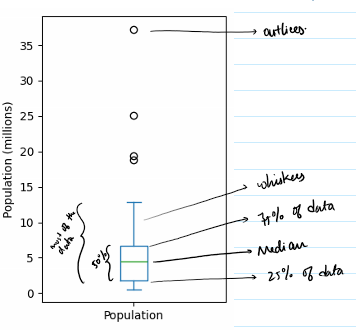
- The IQR is then $Q_3-Q_1$. Basically we consider the 50% of data in the middle of the dataset.
- These metrics are not robust to outliers, A more robust metric would be ‘Median Absolute Deviation from the median’.
Exploring the Data Distribution:
- Instead of summarizing the data into a single number to make some initial sense of the data, we can see visually how the data is distibuted.
- Several plots are developed by statistians to visualise the spread of the data.
- Box plots:
- These are based on the percentile we discussed above.
- The plot indicates outliers, and the 4 quartiles along with the IQR of the data.
- Frequency tables, histograms and density plots:
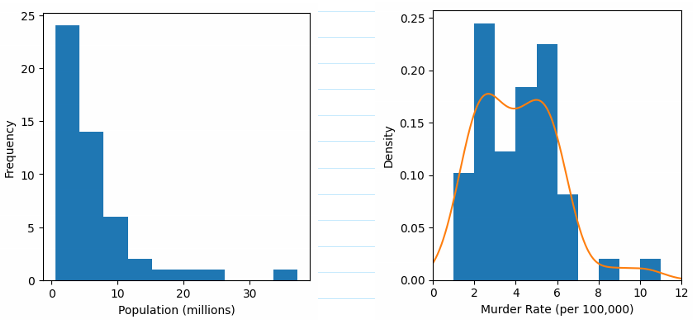
- The data is classified into bins and the count in each bin is called the frequency of the bin.
- We can use a histogram to visualise the data.
- For a density plot we can use a ‘kernal density estimate’ to smoothen the histogram
Correlation:
- In Exploratory data analysis, one of the important concept is to check for correlation.
- Correlation is measuring the relation between two predictors or between predictor and target.
- Say two features x,y. How does y change when the x changes. This measure is called correlation.
- Correlation coefficient is metric used to measure the correlation between two features. Its value lies between (-1 and 1). -1 indicates lower correlation and 1 indicating higher correlation between features.
- Pearson Correlation Coefficient: $\frac{\sum{(x_i-\bar{x})(y_i-\bar{y})}}{(n-1)s_xs_y}$
- When the relation between features are not linear, correlation may not be an important metric.
- This above method of correlation is not robust to outliers.
Exploring two or more variables:
- Some of the plot can be used to explore two or more variables simultaneously.
- Contingency table
- Hexagonal binning
- Contour plots
- Violin plot.